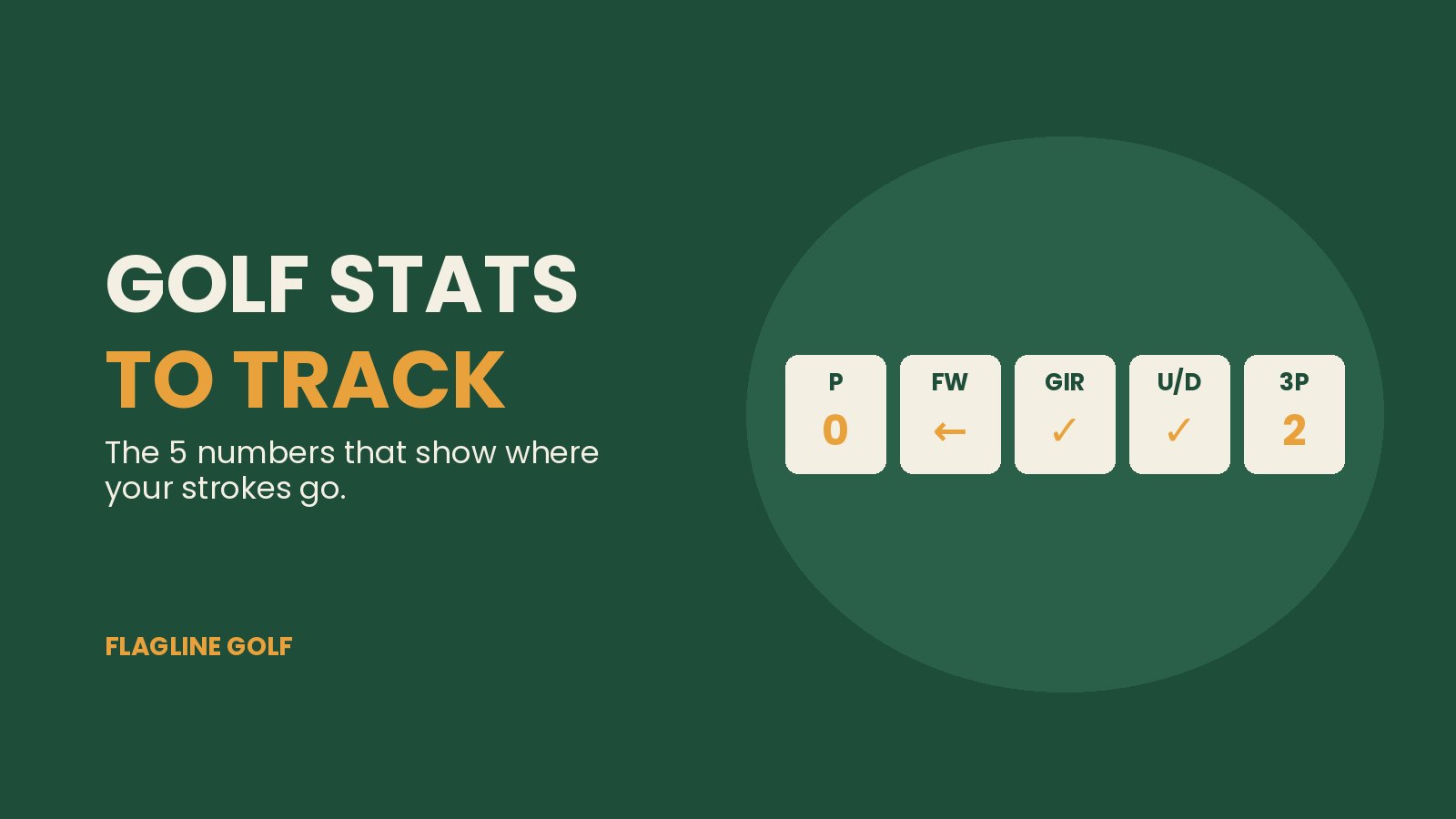
The golf stats to track are the ones that show where your strokes actually go, and for most golfers that’s just five: penalty strokes, fairways, greens in regulation, up-and-downs and 3-putts. You can mark all five on a scorecard in about 30 seconds a hole. After five rounds, the weakest one tells you what to practice.
The 5 stats: penalties (P), fairways (FW), greens in regulation (GIR), up-and-downs (U/D) and 3-putts (3P). Track them for 5 rounds, find the weakest, practice that.
Why most golfers track the wrong things
Most golfers track one of two things: only their score, or everything. A score tells you how you did, not why. Twenty stats per hole tell you why, but nobody keeps it up past round three, and nobody reads the pile of numbers afterwards.
Five stats is the middle ground. Each one points to a part of the game you can practice, and together they cover the whole hole: tee shot, approach, short game and putting, plus the big mistakes.
The 5 golf stats to track (and how to mark them)
1. Penalty strokes
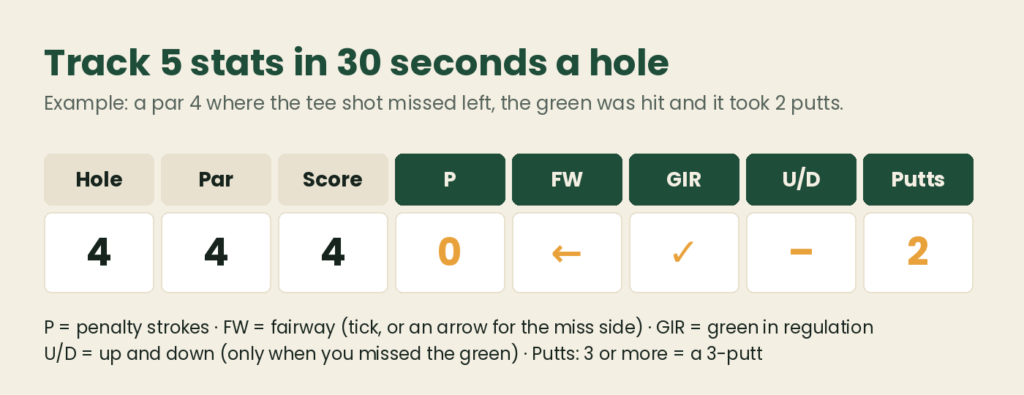
What it is: any stroke added for out of bounds, a lost ball, a penalty area or an unplayable lie. How to mark it: write the number of penalty strokes on the hole (most holes it’s 0). Why it matters: penalties are the most expensive mistakes in golf: a stroke you didn’t hit, often plus a bad next shot. If you average two or more a round, that’s usually the fastest place to find strokes, and the fix is often where you aim rather than how you swing.
2. Fairways hit
What it is: your tee shot finishes on the fairway on a par 4 or par 5. How to mark it: a tick for hit, or an arrow (← or →) for the side you missed. The arrow matters more than the tick, because a miss that’s always on one side can be aimed around.
3. Greens in regulation (GIR)
What it is: your ball is on the green in two strokes fewer than par (1 on a par 3, 2 on a par 4, 3 on a par 5). How to mark it: a tick, or where you missed (short, long, left, right). For higher handicaps, add a second mark for “on or within about 10 yards of the green”: it’s a fairer measure of approach play while you’re building up.
4. Up-and-downs
What it is: when you miss the green, you finish the hole in two more strokes (a chip or pitch plus one putt). How to mark it: on holes where you missed the green, a tick if you got up and down, a cross if you didn’t.
5. 3-putts
What it is: three or more putts on a green. How to mark it: write your number of putts. Anything 3 or more is a 3-putt.
What the numbers say: scratch vs 10 vs 20 handicap
Shot Scope’s data, published by Golf Monthly, shows how these stats change with handicap:
| Stat | Scratch | 10 handicap | 20 handicap |
|---|---|---|---|
| Fairways hit | 50% | 48% | 45% |
| Greens in regulation | 59% | 32% | 14% |
| Up-and-down | 54% | 39% | 31% |
| 3-putt rate | 3% | 7% | 13% |
| Putts per round | 29.9 | 31.2 | 33.4 |
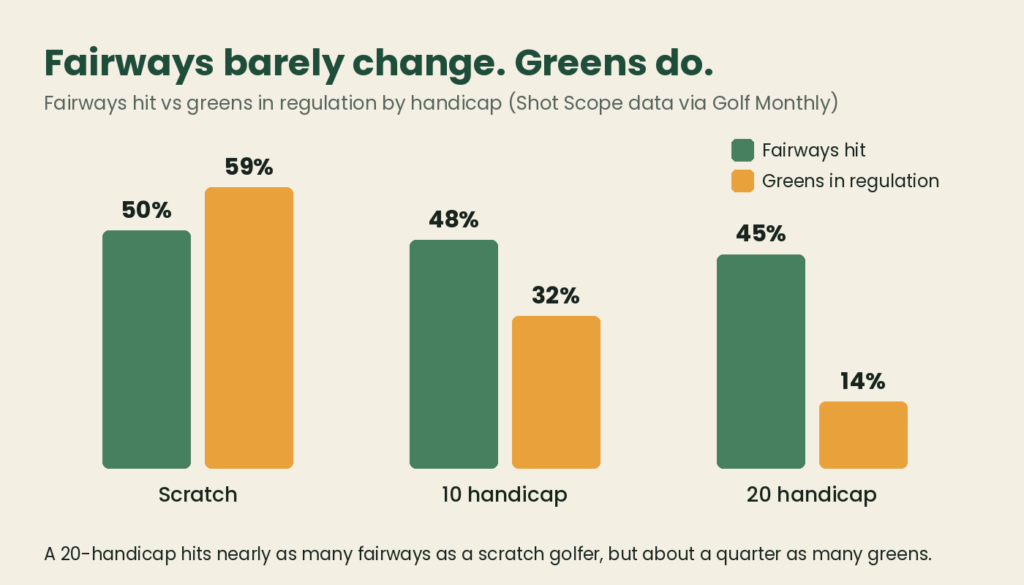
Two things jump out. Fairways barely change: a 20-handicap hits nearly as many fairways as a scratch golfer. Greens change a lot: from 59% down to 14%. For most golfers, approach shots and what happens around the green are where the strokes are, not the driver.
How to track them in 30 seconds a hole
Use five small boxes under each hole on your scorecard, in the same order every time: P, FW, GIR, U/D, putts. Mark them walking to the next tee, not at the end of the round. That’s the whole system.
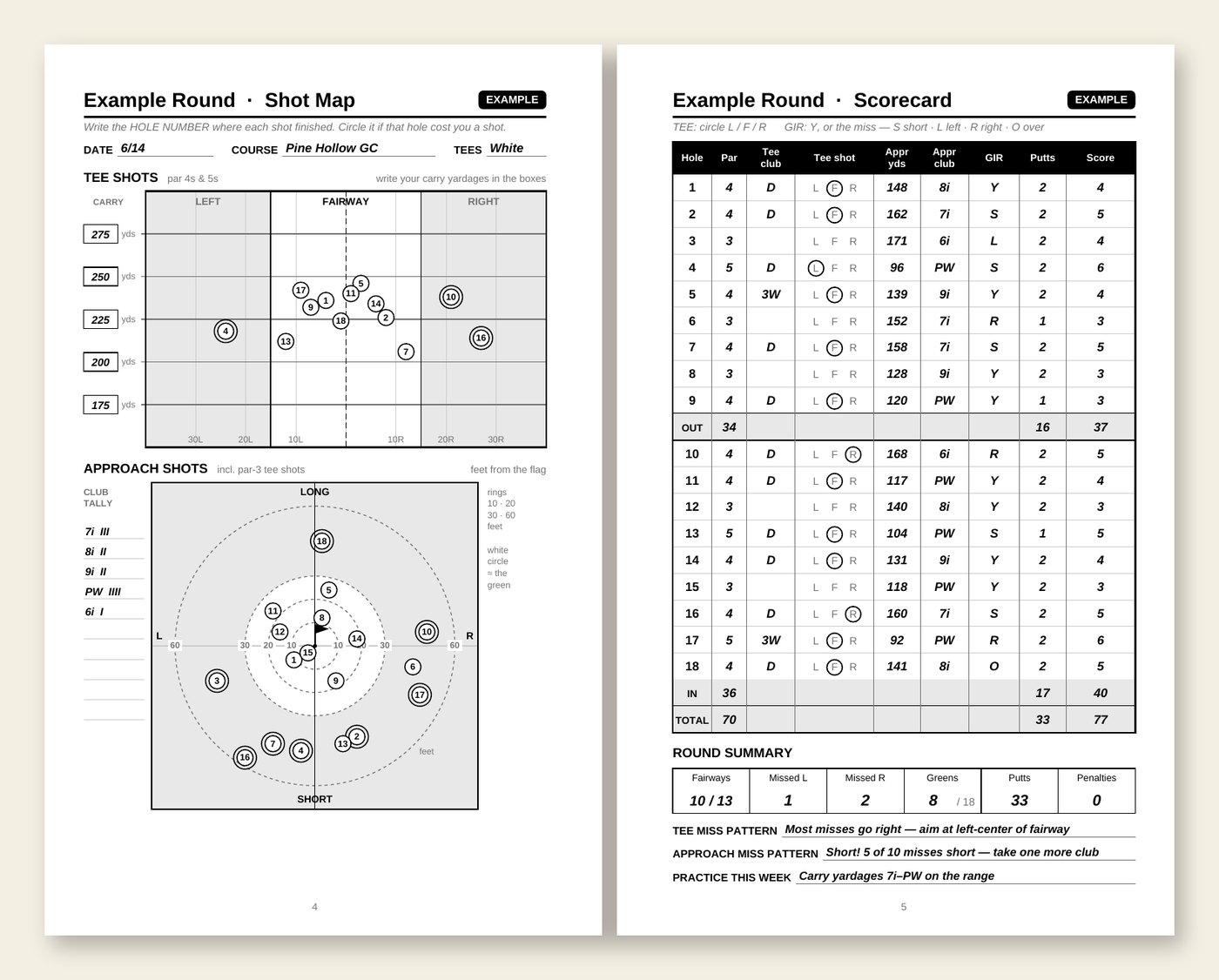
If you like paper, our Shot Dispersion Notebook puts a scorecard next to a tee-shot grid and an approach grid, so you can see where the misses went as well as how many. If you’d rather use your phone, the free Flagline Golf app records the same stats and adds them up for you.
After 5 rounds: pick your one thing
Five rounds is enough to see a pattern without waiting all season. Add up each stat and compare it with the table above for your handicap:
- Penalties of 2 or more a round: work on where you aim off the tee and which club you hit. Start with our guide to finding your golf miss pattern.
- GIR well below your handicap’s number: look at where you miss greens. If most misses are short, you probably need more club. Our guide to golf shot dispersion shows how to aim with your pattern.
- Up-and-downs low: short game practice, especially chipping to a landing spot.
- 3-putts high: lag putting from 20 to 40 feet, not short putts.
Pick one. Practice it for a month, then track 5 more rounds and see if it moved.
Golf stats FAQ
Is putts per round a good stat?
On its own, not really. A golfer who misses lots of greens and chips close will have few putts, and one who hits lots of greens from far away will have more. 3-putts and up-and-downs tell you more about putting and short game than total putts.
How many rounds do I need before my stats mean something?
About five rounds gives a useful picture of where your strokes go. Ten is better. Keep tracking after that, so you can see whether practice is changing the numbers.
Should I track stats on paper or in an app?
Whichever you’ll keep doing. Paper is quick and doesn’t need your phone on the course. An app adds up the numbers for you. Many golfers mark a scorecard during the round and enter it later.
What is strokes gained?
Strokes gained compares each shot with what an expert would average from the same spot, to show which part of your game gains or loses strokes. It’s powerful but needs the distance of every shot. The five stats here are the simple version you can keep on a scorecard.
Start tracking this round
Want to try it on paper first? Join the Flagline list below for the free Practice Printables Pack, which includes an on-course stats card.
Sources
- Golf Monthly, “Scratch vs 10 vs 20 Handicap: How The Stats Compare” (Shot Scope data, updated April 2025): golfmonthly.com
- GOLF.com and GOLFTEC, key stats for lowering your handicap (further reading): golf.com