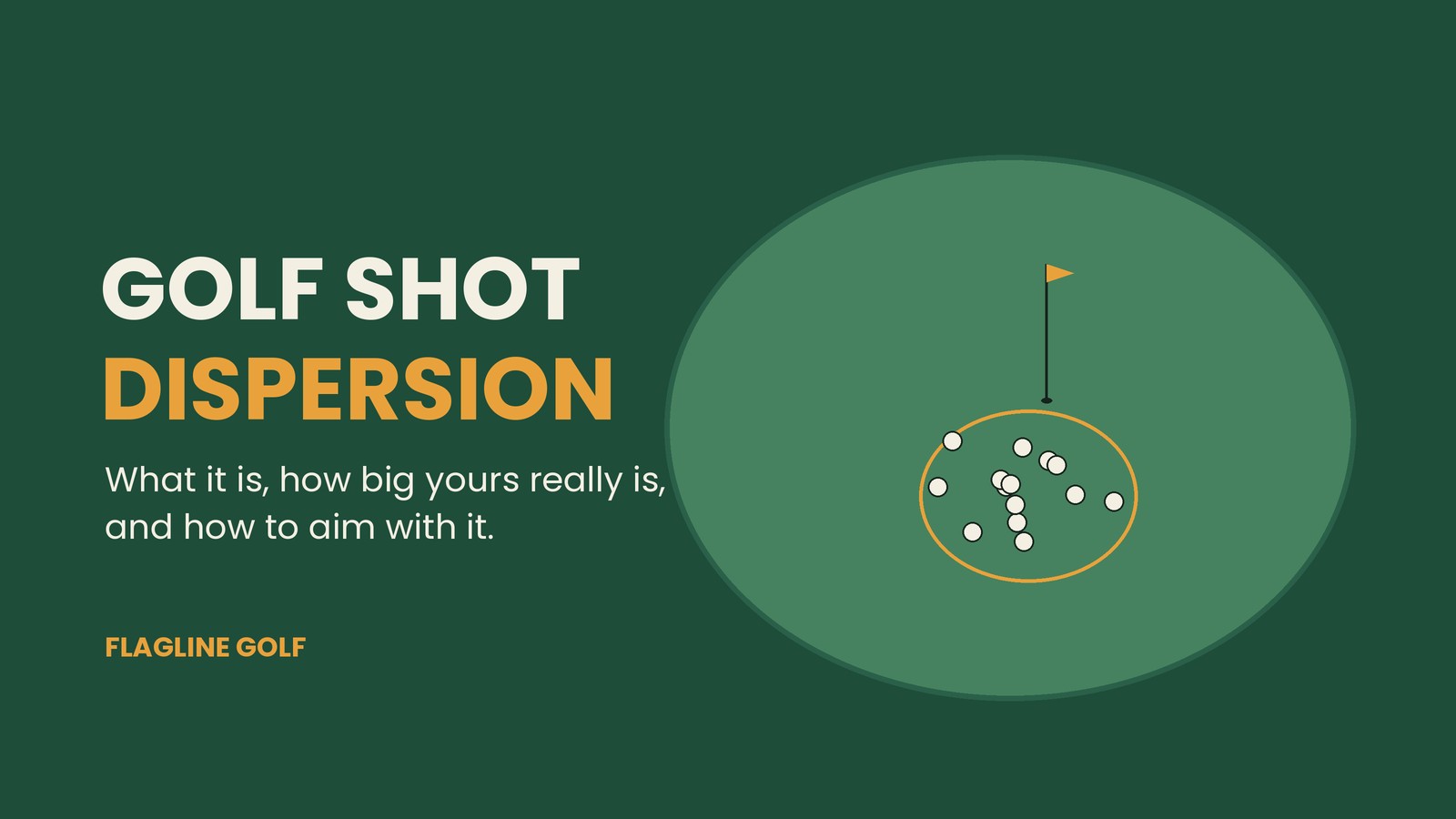
Every golfer has a number for each club. “My 7-iron goes 150.” The trouble is that the number is really an average, and the ball almost never lands on it. Where it does land, shot after shot, is your golf shot dispersion: the spread of finishing spots you get when you hit the same club at the same target.
Once you know the size and shape of that spread, a lot of golf gets simpler. You know which pins to attack, which club to hit, and where to aim so a normal miss still ends up somewhere safe. This guide explains what dispersion is, how big it really is (bigger than most of us think), and how to aim with it.
What is shot dispersion?
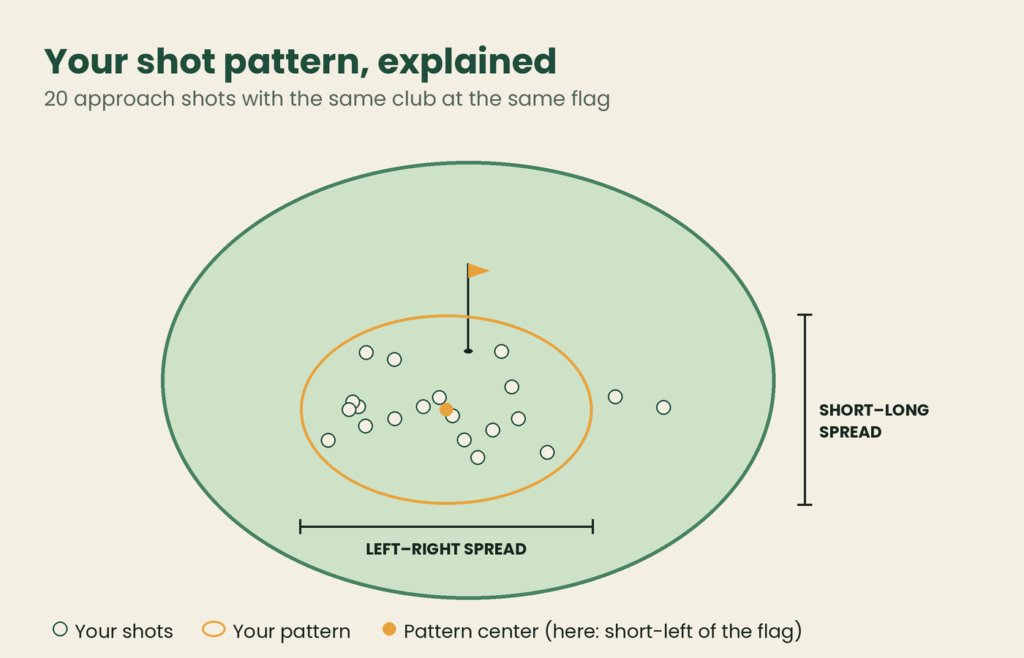
Hit 20 balls with one club at one flag and they won’t land in one spot. They’ll land in a rough oval. That oval is your pattern, and it has three parts worth knowing:
- Left–right spread: how wide the oval is. This decides how much room you need either side of your target.
- Short–long spread: how deep it is. For most amateurs this is bigger than the left–right spread on approach shots, because of thin and fat contact.
- The center of the pattern: where your shots land on average. It’s often not at the flag. Many golfers find their center is short of where they aimed.
How big is a normal golfer’s dispersion?
Bigger than it feels. Shot Scope looked at real on-course 7-iron shots and counted how often golfers finished within 5 yards of their own average distance. The answer, as reported by MyGolfSpy:
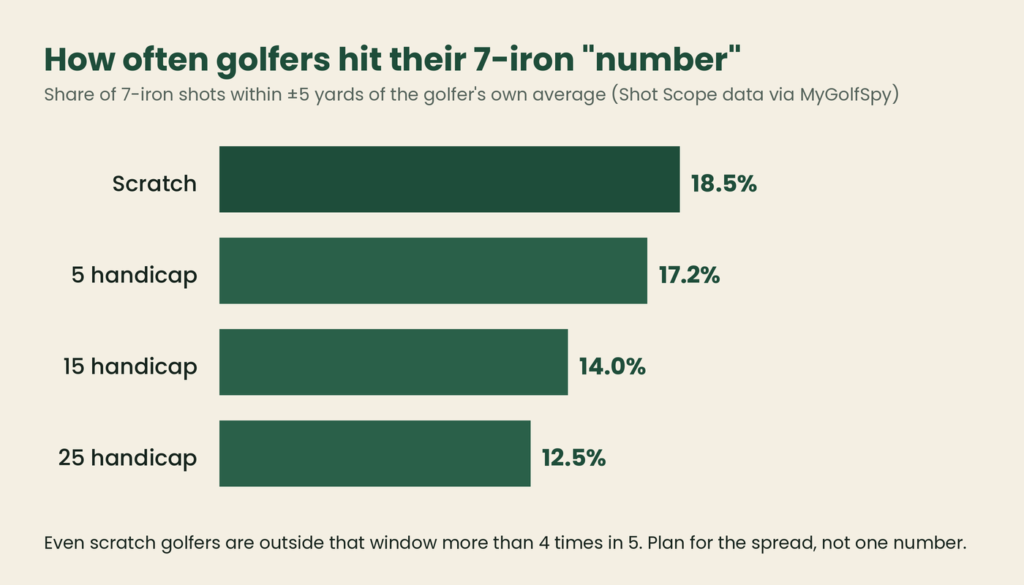
Even scratch golfers were inside that 10-yard window only about 1 time in 5. A 25-handicap was there about 1 time in 8. The difference between good and average players is smaller than you might expect; nobody hits their number most of the time.
That’s the most useful thing to take from the data: your “7-iron distance” isn’t a number, it’s a window. If your average is 150, a realistic window might run from the low 140s to the mid 150s, plus the occasional real miss. Plan for the window and you’ll make better decisions than someone who plans for the number.
Why dispersion matters more than your best shot
Your scores come from the whole pattern, not the one pure strike. Two golfers with the same average distance can score very differently if one has a tight pattern and the other a wide one. Dispersion tells you:
- Which flags to aim at. If your pattern is 30 yards wide and the pin is 8 yards from water, aiming at it puts part of your pattern in the water every time.
- Which club to hit. If your pattern is centered short, the “right” club by the yardage is often one club too little.
- What to practice. A pattern that’s mostly deep (short–long) points to contact. A pattern that’s mostly wide points to face and path.
How to aim with your pattern
Here’s the idea in one picture. Same golfer, same 20 shots. The only thing that changes is where they aim.
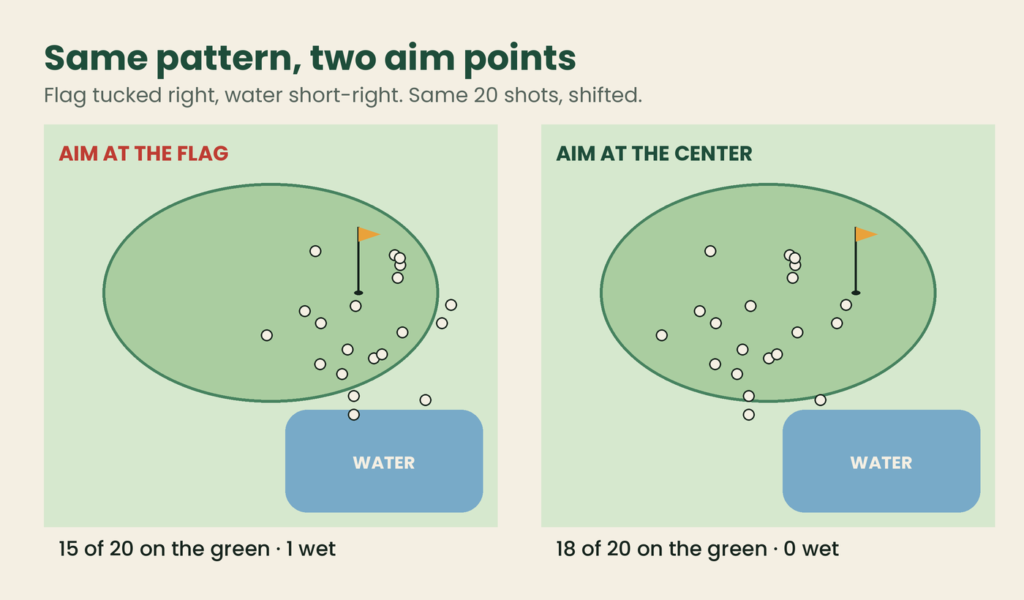
A simple way to put this into practice on the course:
- Picture your pattern over the green. Not a dot at the flag, but the oval you actually hit.
- Slide it until the trouble is outside it. If water is right, move the oval left until it’s clear. Where the center of the oval ends up is your aim point.
- Pick the club for the center of the green, not the flag, especially if your pattern runs short. Long of a middle pin is usually still on the green; short often isn’t.
- Go at the flag only when your whole pattern fits. A wide-open pin in the middle of a big green is a green light. A tucked pin behind a bunker usually isn’t.
The same thinking works off the tee: if your drives mostly miss right, aim down the left-center so your normal miss finishes in the fairway.
How to measure your own dispersion (no launch monitor needed)
You don’t need gadgets. You need a record of where shots finished, kept for a few rounds. I wrote a step-by-step guide here: How to find your golf miss pattern (no launch monitor needed). The short version:
- On the course: after each tee shot and approach, mark where it finished compared with the target. Write the hole number instead of a dot so you can look back later.
- Give it 5 rounds. One round is noise. After five, the pattern is hard to argue with.
- On the range or a simulator: hit 10 balls with one club at one target, mark each one, and drop only obvious mishits. If you have a launch monitor, log carry and left/right for each shot, not just the average.
- Then read it: short or long? Left or right? How wide? Which misses cost you a shot? Those answers tell you how to aim and what to practice first.
Track it in one place
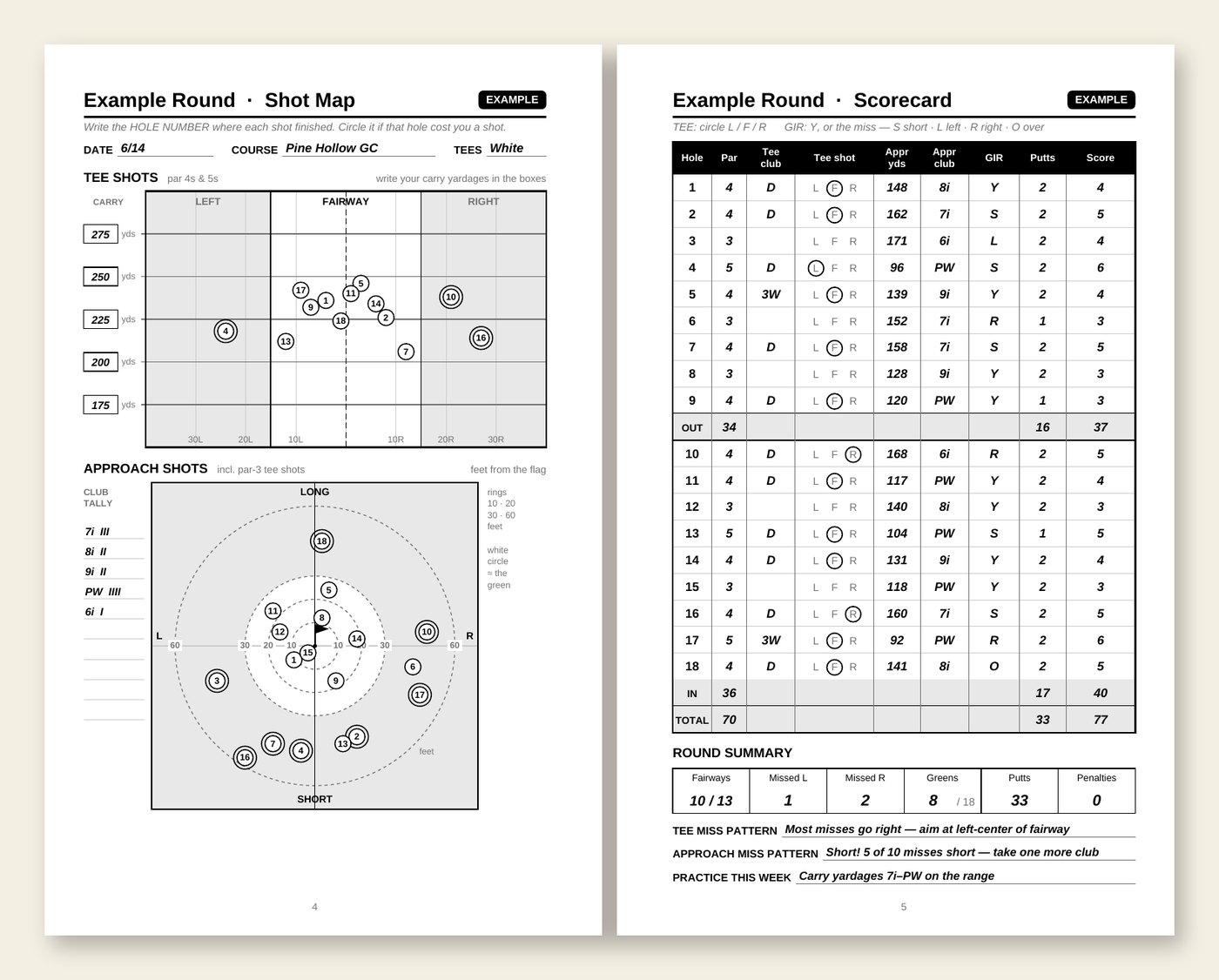
You can do all of this on the back of a scorecard. I built the Shot Dispersion Notebook to make it quicker: a tee-shot grid with your own yardages, an approach grid with 10/20/30/60 ft rings, and a scorecard on the facing page, so a whole round fits on one spread and your pattern shows up after a few rounds. If you practice on a range or simulator, the Range Practice Notebook and Sim Session Logbook do the same for practice sessions.
Prefer your phone? In the Flagline Golf app you tap where each shot finished, and your miss pattern builds up round by round.
Shot dispersion FAQ
How many shots do I need to know my dispersion?
On the course, about 5 rounds of tee shots and approaches gives a useful picture. On the range or a simulator, 10 to 20 shots with one club is a good start. More is better, but a rough pattern you actually use beats a perfect one you never look at.
Does a launch monitor help?
Yes, for practice: it gives you exact carry and left/right numbers for every shot. But range and simulator shots come from perfect lies with no pressure, so your on-course pattern is usually wider. Track both if you can.
What’s a “good” dispersion?
There isn’t one target number for everyone. What matters is knowing yours, then aiming and choosing clubs so it fits the hole. Shrinking it comes next, and your pattern tells you whether to work on contact (short–long) or direction (left–right).
Should I always aim at the middle of the green?
Not always. Aim where your whole pattern stays out of trouble. For a center pin on a big green, that may be the flag. For a pin tucked near water or a bunker, it’s usually toward the fat side of the green.
Want to try it first? Join the Flagline list below and get a free printable sample of the Shot Dispersion Notebook.