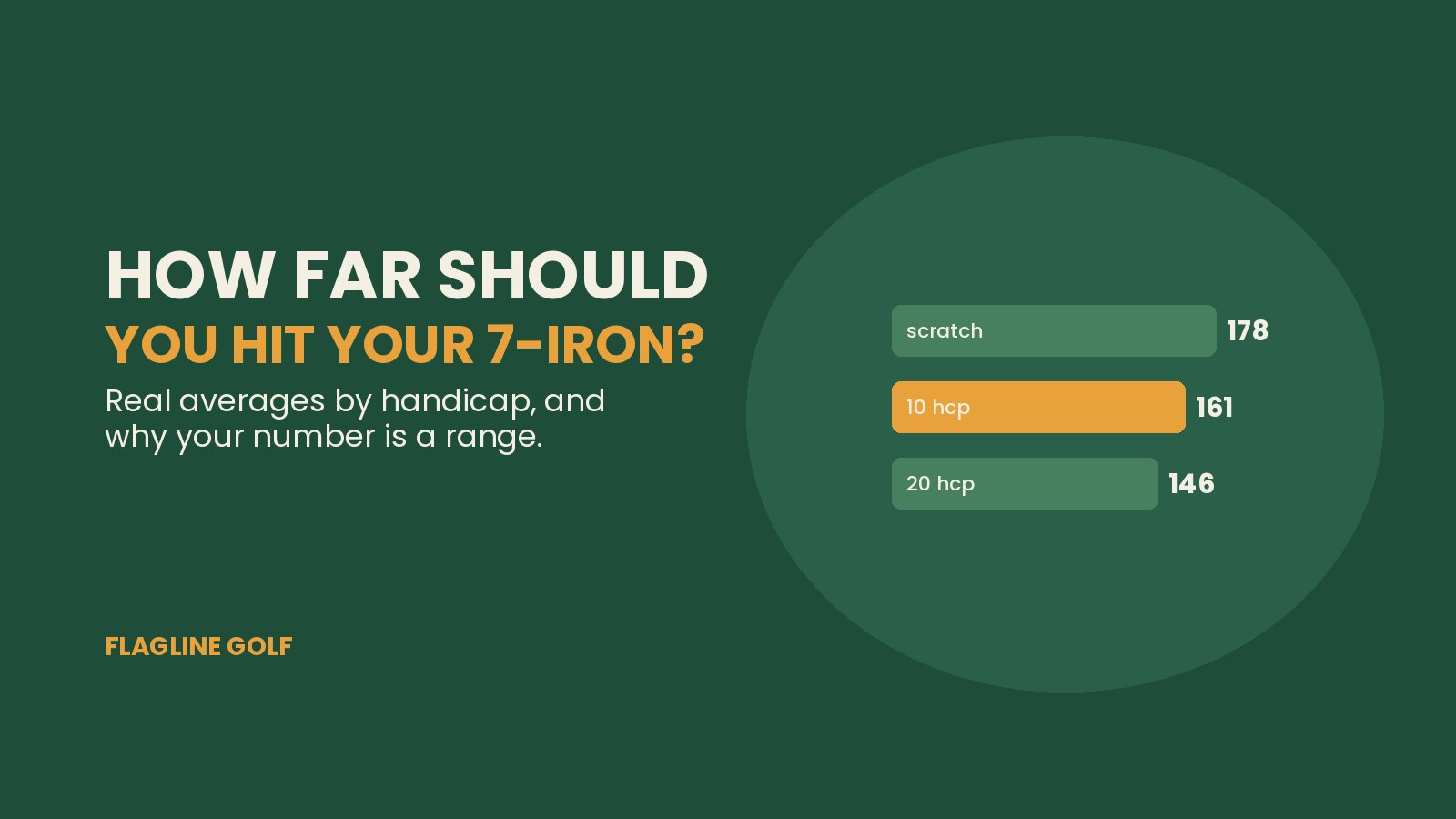
How far should you hit your 7-iron? The average amateur hits it about 155 yards, according to Shot Scope’s 2026 data. By handicap that runs from about 178 yards for scratch golfers to about 132 for a 25-handicap, and the average female amateur hits it about 119 yards. But the more useful answer is this: your 7-iron isn’t one number. It’s a range, and knowing your range matters more than matching anyone’s average.
Quick answer: Men: about 155 yds on average (scratch 178, 10 hcp 161, 20 hcp 146). Women: about 119 yds on average (scratch 149, 10 hcp 126, 20 hcp 107). Source: Shot Scope via Golf Monthly, 2026.
Average 7-iron distance by handicap
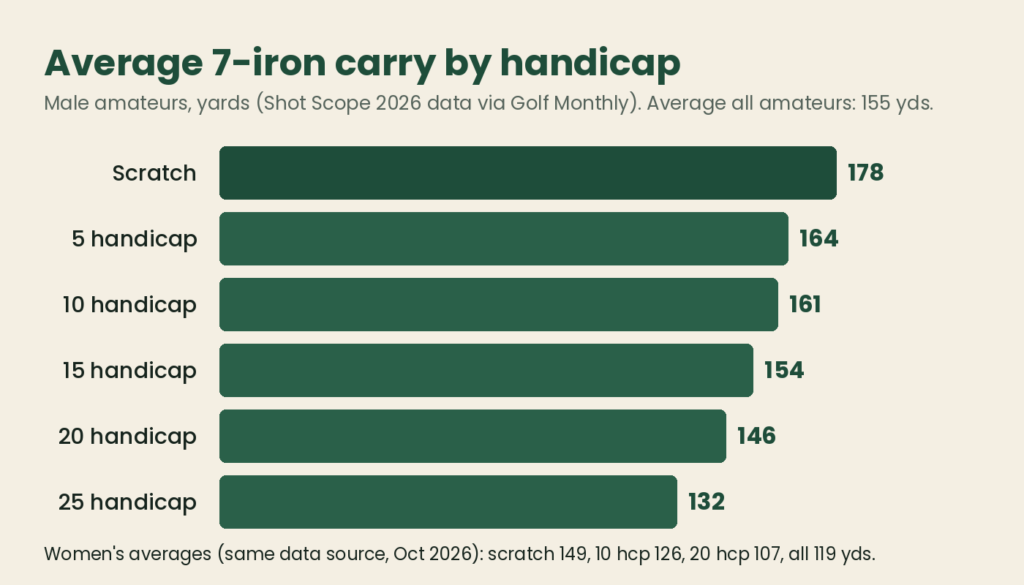
Shot Scope’s on-course data, published by Golf Monthly in June 2026, gives these average 7-iron carry distances for men:
| Handicap | Average 7-iron (yards) |
|---|---|
| Scratch | 178 |
| 5 | 164 |
| 10 | 161 |
| 15 | 154 |
| 20 | 146 |
| 25 | 132 |
| All amateurs | 155 |
And for women, from Shot Scope data published by Golf Monthly in October 2026:
| Handicap | Average 7-iron (yards) |
|---|---|
| Scratch | 149 |
| 5 | 138 |
| 10 | 126 |
| 15 | 119 |
| 20 | 107 |
| 25 | 103 |
| 30 | 98 |
| All female amateurs | 119 |
These are averages from real rounds, so they include wind, lies and slopes. Range or simulator numbers on perfect lies usually come out a little longer.
Why distance isn’t the goal
It’s easy to look at that table and decide you need more speed. But two other numbers matter more for scoring.
How often you hit the green. Shot Scope’s data, reported by MyGolfSpy, shows scratch golfers hit the green with a 7-iron far more often than higher handicaps. The gap is about where the ball finishes, not just how far it goes.
How often you hit your own number. Even scratch golfers finish within 5 yards of their own 7-iron average only about 18.5% of the time on the course; for a 25-handicap it’s about 12.5% (MyGolfSpy, Shot Scope data). Nobody hits their number most of the time. That’s why the useful question is “what’s my range?” and not “what’s my number?”
How to find your real 7-iron distance
You can do this in one range or simulator session:
- Warm up first. Your first 10 balls aren’t your real distance.
- Hit 10 balls with your 7-iron at one target, with your normal swing, not your hardest.
- Drop the worst 2 (the real mishits).
- Average the carry of the other 8. With a launch monitor, use carry, not total. On a range, use the yardage markers and where each ball lands.
- Write down the shortest and longest of the 8 too. That’s your range, and it’s the number to plan with on the course.
Example: carries of 141, 144, 145, 147, 148, 150, 151 and 154 give an average of about 148, and a range of 141 to 154. On the course, that golfer should think “about 148, could be 141,” which is very different from “my 7-iron goes 150.”
Repeat with each club and you’ve built a gapping chart: your real distance and range for every club in the bag.
What changes your 7-iron distance
- Swing speed. More club speed means more ball speed. Trackman reports the average male golfer’s driver ball speed at about 133 mph versus 161 mph for scratch-or-better players (Trackman), and the same gap shows up through the bag.
- Strike. A thin or toe strike can cost far more distance than a slower swing. Strike is often the cheapest distance to find.
- Loft. Modern 7-irons often have stronger lofts than older sets, so two golfers’ “7-irons” can be different clubs. Compare by loft, not by the number on the sole.
- Weather and ball. Cold air and a cold ball both cost distance, so winter numbers usually come out shorter than summer ones.
How to track it
Write your 7-iron average and range in one line after each session: date, club, average carry, shortest, longest. Do it again every few weeks and you’ll see whether your range is getting tighter, which matters more than the average going up.
Our Range Practice Notebook has gapping pages for every club. If you practice with a launch monitor, the Sim Session Logbook is built for exactly this. Our guide to golf shot dispersion shows how to use your range when you aim.
7-iron distance FAQ
Is 150 yards good for a 7-iron?
For an adult male amateur, about 150 yards is close to the average (155 yards in Shot Scope’s 2026 data) and right around a 15-handicap’s number. For most women, 150 would be well above average. “Good” is the distance you hit consistently and know.
Should I measure carry or total distance?
Carry. Carry is how far the ball flies, and it’s what decides whether you clear a bunker or reach a front pin. Roll changes with firm and soft ground; carry doesn’t change nearly as much.
Should beginners worry about 7-iron distance?
Not much. Solid contact and a repeatable swing come first, and distance tends to follow. Knowing your real distance does help beginners pick the right club, so it’s still worth measuring.
How far should a junior or a senior hit a 7-iron?
It varies too much by age, strength and swing speed to give one honest number. The method above works for anyone: measure your own average and range, then plan around them.
Measure yours this week
Join the Flagline list below for the free Practice Printables Pack: a practice plan, club distance chart, range cards, stats card and more.
Sources
- Golf Monthly, “How Far Does The Average Amateur Golfer Hit Their 7-Iron In 2026?” (Shot Scope data, June 2026): golfmonthly.com
- Golf Monthly, “How Far Does The Average Female Golfer Hit Their 7-Iron In 2026” (Shot Scope data, Oct 2026): golfmonthly.com
- MyGolfSpy, “The Stock Yardage Myth” (Shot Scope data): mygolfspy.com
- MyGolfSpy, “How Far Should You Hit Each Iron? (2026 Data For Your Handicap)”: mygolfspy.com
- Trackman, ball speed averages: trackman.com