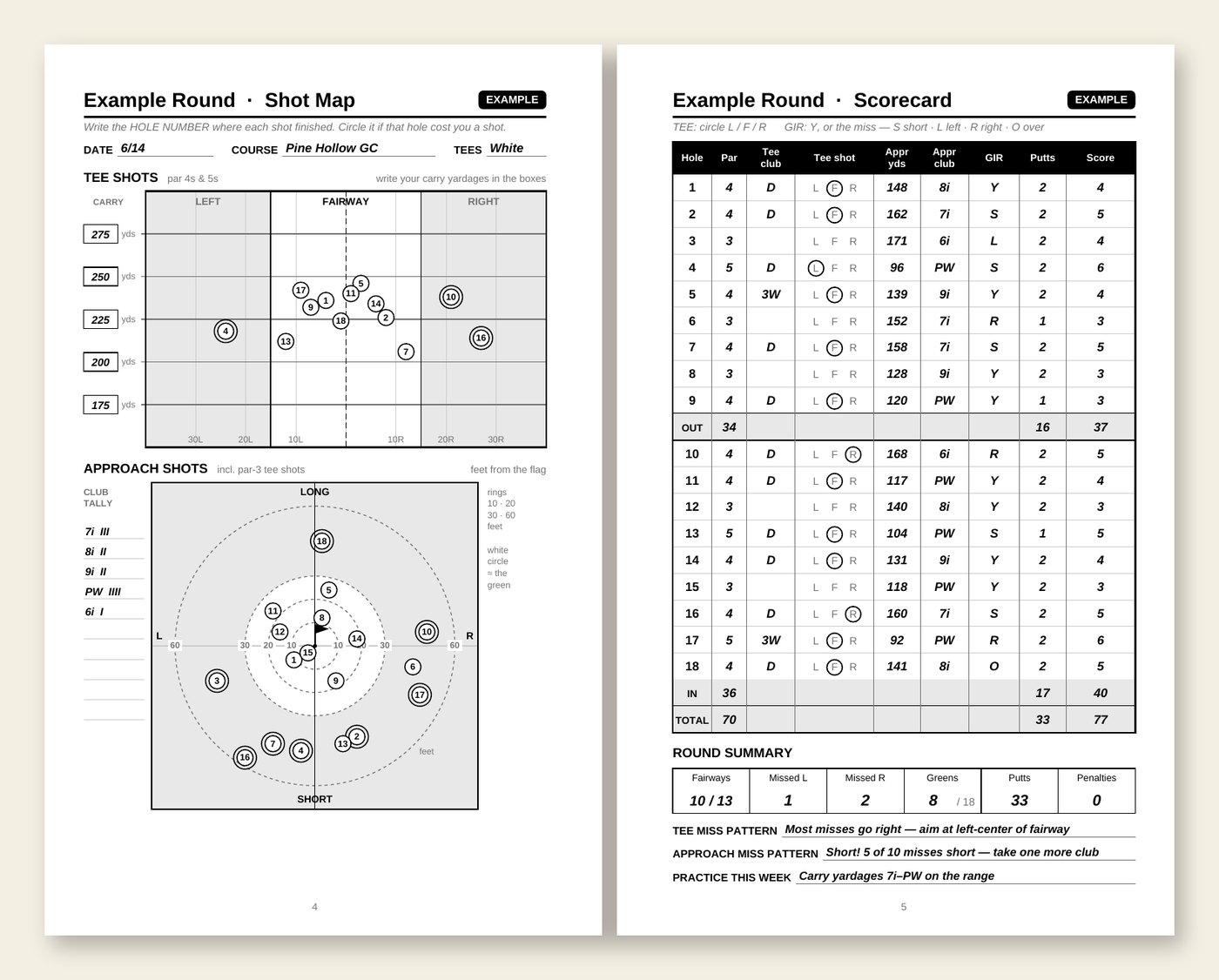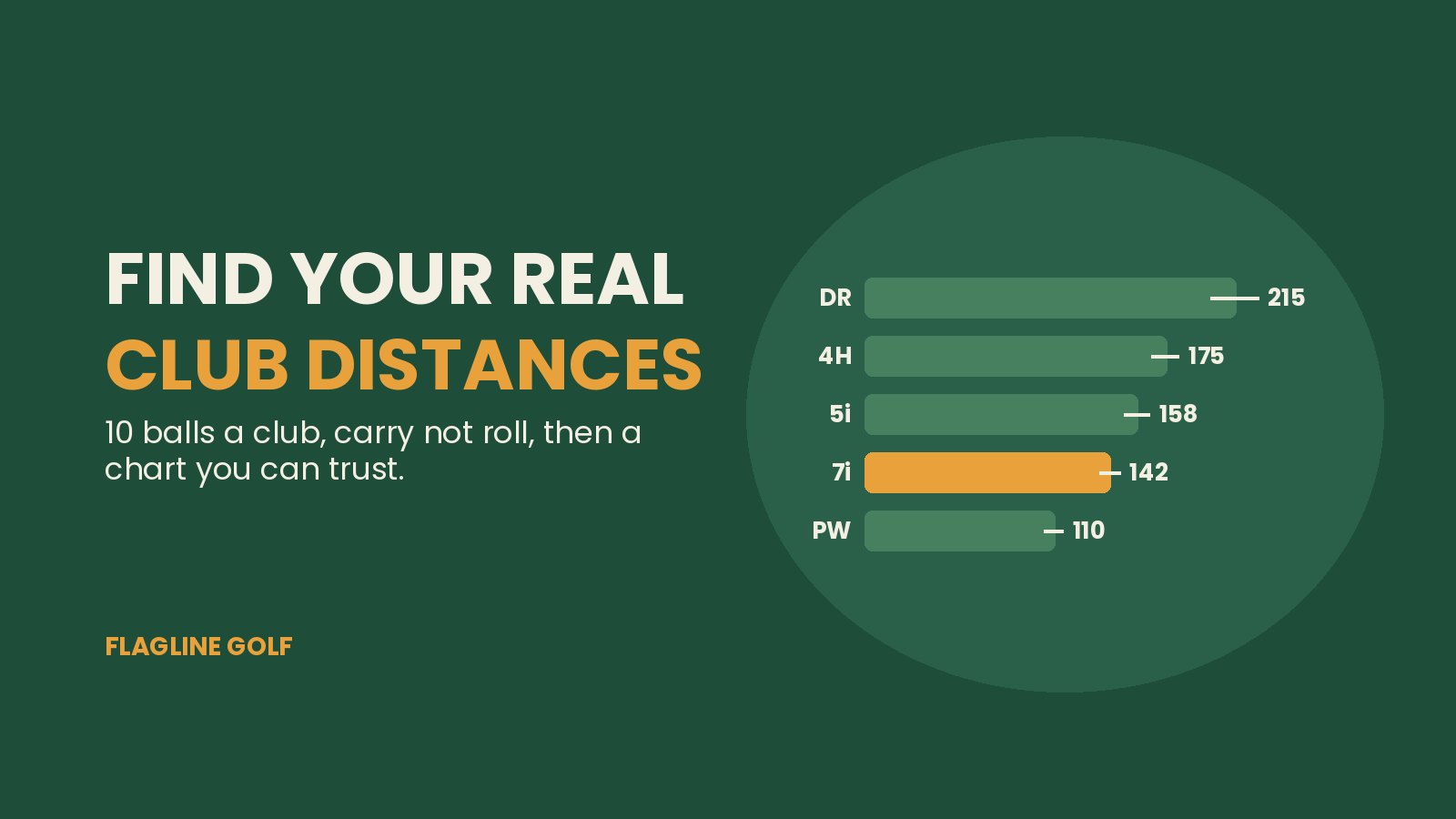
The quickest way to find your golf club distances is to hit 10 balls with one club, measure where each one lands (carry, not roll), drop the two best and the two worst, and average the rest. Do that for every club, write the numbers in a chart, and you’ll know which club to hit far better than any “average distance” table can tell you. This guide shows how to find your golf club distances three ways (launch monitor, range, on the course) and how to turn them into a chart with our free tool.
Quick answer: 10 balls per club → note the carry of each → drop the 2 best and 2 worst → average the middle 6. Keep three numbers per club: typical carry, the short end and the long end. Put them in the free golf club distance chart builder and check the gaps.
Why your “stock” numbers are probably too long
Most golfers know their best 7-iron, not their normal one. The data shows how much that costs:
- Hardly anyone hits their exact number. Shot Scope data via MyGolfSpy found scratch golfers hit a 7-iron within 5 yards of their own average only about 18.5% of the time, and 25-handicaps about 12.5%.
- Amateurs miss short. From 100 yards, Shot Scope data via MyGolfSpy shows 14% of scratch golfers’ shots finish short of the green, rising to 39% for 20-handicaps and 46% for 25-handicaps.
If your numbers come from your best swings, you’ll come up short most of the time. A distance that comes from the middle of your shots fixes that.
Carry vs total distance
Carry is how far the ball flies before it lands. Total adds the roll. Use carry for your chart: it’s what gets you over a bunker or onto a green, and it doesn’t change with how firm the ground is. Roll matters too, but it changes every day.
Method 1: a launch monitor or simulator
This is the most accurate way, because every shot gets a carry number.
- Warm up first. Cold swings give short numbers.
- Hit 10 balls with one club at one target, with a normal swing, not your hardest.
- Write down the carry of each shot (most launch monitor apps show a list).
- Drop the 2 longest and 2 shortest, then average the middle 6. That’s your typical carry.
- Note the shortest and longest of those 6 too. That’s your window: the range most of your shots fall in.
Indoors, use the same balls each time and check your launch monitor’s setup instructions, so every session is measured the same way.
Method 2: on the range
- Find a flag with a known distance. Use a rangefinder or the range’s own signs.
- Hit 10 balls with one club at that flag and watch where each one lands, not where it stops.
- Count how many land short, about pin-high and long. If most land short of a 150-yard flag, your club is not a 150-yard club.
- Move to a closer or farther flag until most land around it.
Range balls can fly differently from the ball you play, so treat range numbers as close, not exact. If your range allows your own balls, use them for this.
Method 3: on the course
Over a few rounds, for normal full shots only:
- Note the yardage, the club and where the ball landed (on the green, short, long).
- On par 3s, a laser or GPS gives an exact carry for any ball that lands on the green.
- After 5 rounds, look for each club’s pattern. On-course numbers are usually a little shorter than range numbers, and those are the ones that count.
Turn the numbers into a chart
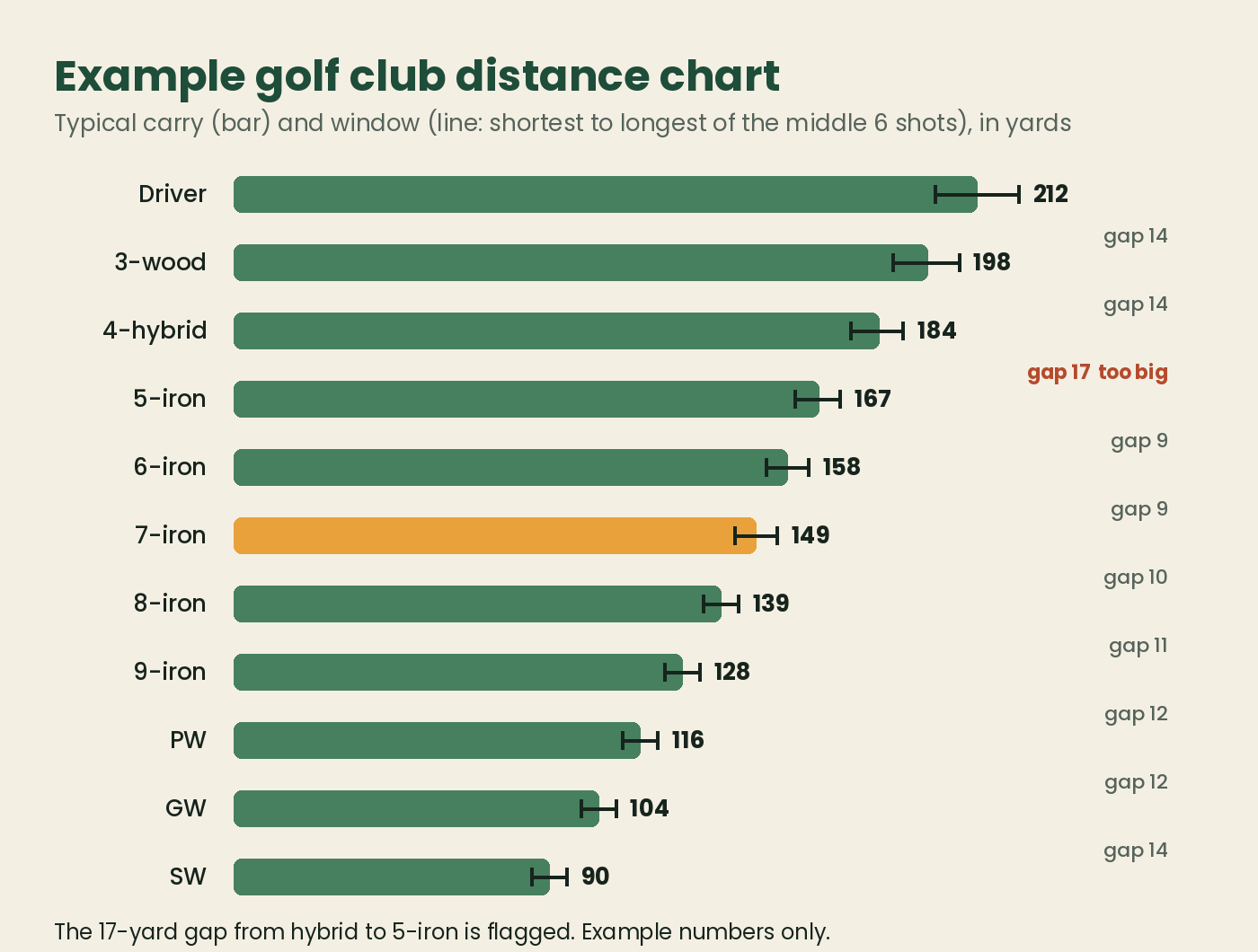
Open the free golf club distance chart builder, type in each club’s typical carry, and it sorts them, works out the gaps and flags anything odd. Then print it or save it as a PDF for your bag.
What to look for:
- Gaps of roughly 8 to 15 yards between clubs. Much bigger and there’s a distance you can’t hit with a full swing.
- Two clubs that go the same distance. One of them is doing nothing; your fitter or pro can tell you whether that’s the club or the swing.
- The long clubs. Slower swings often get very small gaps between the 4-iron, 5-iron and hybrids. That’s normal, and worth knowing.
Curious how your 7-iron compares? Our post on how far you should hit your 7-iron has 2026 averages by handicap for men and women. But your own chart is the one that picks clubs.
Use your window, not just one number
The window is where the strokes are. If your 7-iron carries 140 to 152 with a typical carry of 146, a 150-yard shot over water needs more club, and a 140-yard shot to a back pin is fine with it. Our guide to golf shot dispersion shows how to use the whole pattern to aim, and the free shot dispersion chart draws yours.
How often to update it
Check your chart at the start of each season, after new clubs or a lesson, and whenever the weather changes a lot (cold air and wet ground shorten carries). A 10-ball check per club takes about 20 minutes on a launch monitor.
Golf club distances FAQ
How many balls do I need per club?
Ten is a good start: enough to drop the best and worst and still have six good numbers. Twenty over two sessions is better for the clubs you hit most.
Should I use my best shots?
No. Use the middle of your shots. Planning off your best strike is the main reason amateurs come up short.
Are range balls accurate for distances?
They’re close but not exact, because range balls can fly differently from your own ball. Use them to get in the right area, then confirm on the course or with your own balls.
What if I don’t have a launch monitor?
Use a rangefinder on the range (Method 2) and par-3 tee shots on the course (Method 3). Write each one down; five rounds gives you a solid picture.
Build yours today
Want it on your phone and updated from every session? Try the free Flagline Golf app.
Join the Flagline list below for the free Practice Printables Pack: a practice plan, club distance chart, range cards, stats card and more.
Sources
- MyGolfSpy, “The Stock Yardage Myth: How Often Amateurs Actually Hit Their Number” (Shot Scope data): mygolfspy.com
- MyGolfSpy, “100 Yards Feels Like A Scoring Shot But The Data Says Otherwise” (Shot Scope data): mygolfspy.com
- Golf Monthly, “How Far Does The Average Amateur Golfer Hit Their 7-Iron In 2026?” (Shot Scope data): golfmonthly.com