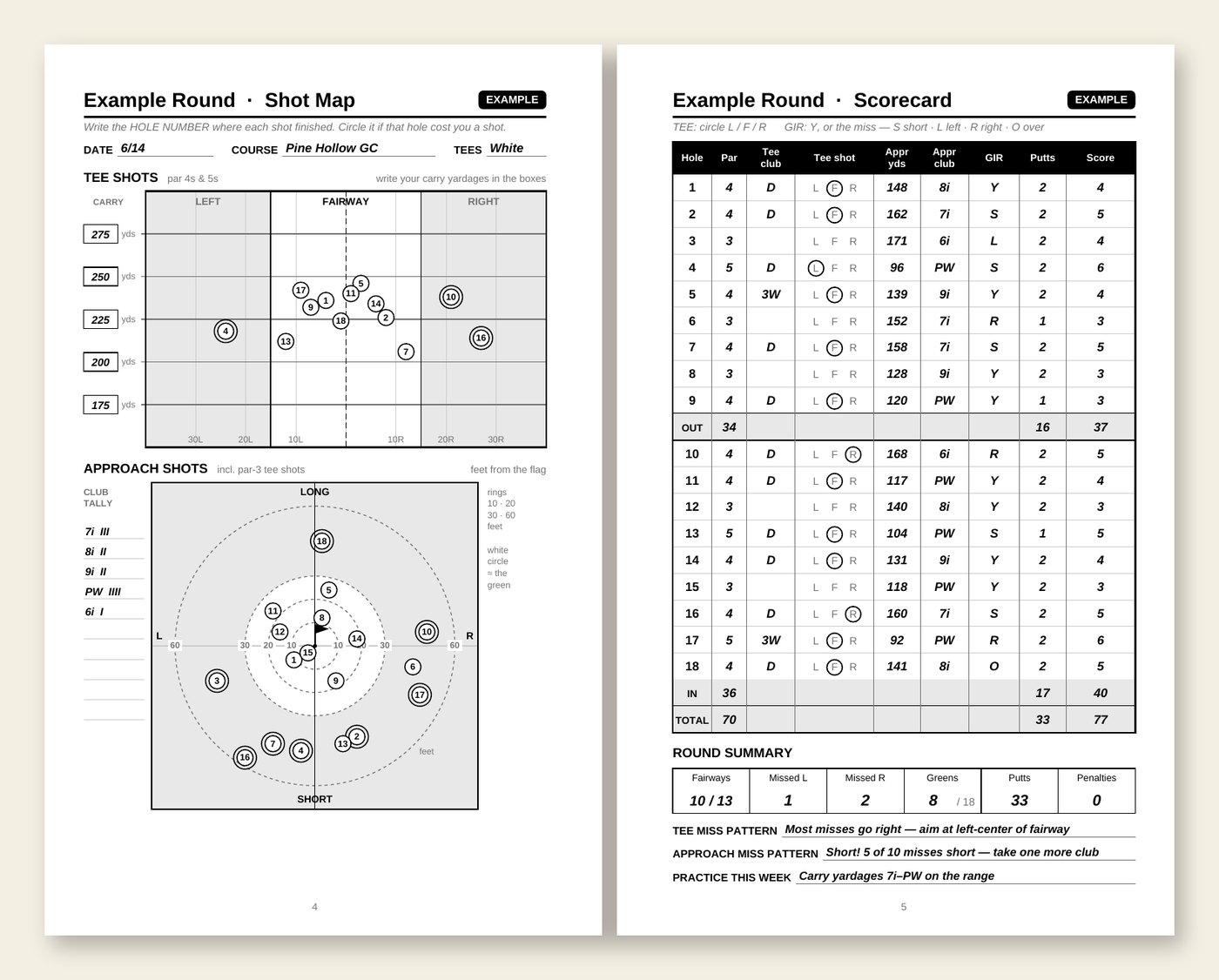
A good winter golf practice plan doesn’t need a simulator, a heated range or an hour a day. It needs three short sessions a week at home, aimed at the parts of your game that cost the most strokes: putting, chipping and a repeatable swing. Below is a 4-week plan that fits in a hallway, a living room and a garage, plus a test at the start and end so you can see whether it worked.
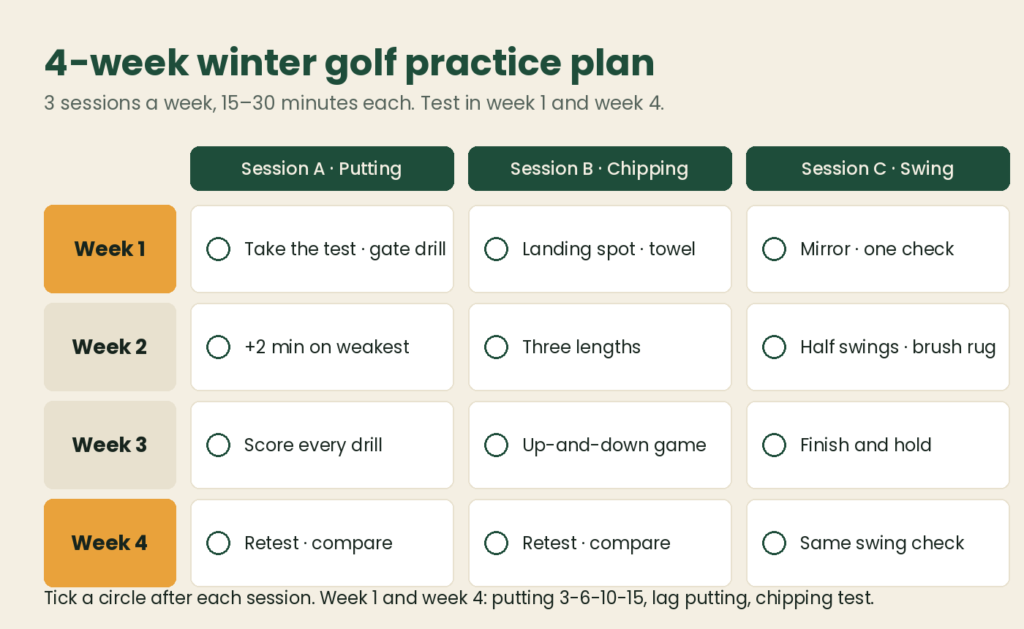
Quick plan: 3 sessions a week, 15 to 30 minutes each, for 4 weeks. Session A = putting, Session B = chipping and short game, Session C = slow-motion swing and strike. Test yourself in week 1 and again in week 4.
Why winter practice should be short game first
When the course is closed, most golfers either stop completely or hit balls into a net and hope. The better trade is the short game. Shot Scope data published by Golf Monthly shows scratch golfers 3-putt about 3% of the time and 20-handicaps about 13%, and get up and down 54% versus 31% of the time. Those are strokes you can work on from your living room.
There’s a second reason. Short, regular sessions build habits, and habits survive the winter better than one big range day in March. Twenty minutes three times a week is roughly 15 hours of practice by the time the season starts.
What you need (you probably own it already)
- A putter, a wedge and 5 to 10 balls (foam or plastic balls for any full or half swings indoors)
- A rug or carpet strip about 15 feet long, and a hallway if you have one
- Two coins, a tee or a coffee mug as targets, and a towel
- A full-length mirror or your phone on a stand, for swing work
- A notebook or the Flagline app to log each session in one line
Safety first: indoors, only putt and chip with real balls. Use soft balls for anything bigger, and check the ceiling and the lights before you swing.
The 4-week winter golf practice plan
Session A: putting (15 to 20 minutes)
- Start line, 5 minutes. Put two tees just wider than a ball, 12 inches in front of the ball, and roll putts through the gate from 4 feet. This trains the face, which decides where the ball starts.
- Ladder, 5 minutes. Putt to 10, 15 and 20 feet along the rug and try to stop each ball within a putter length past the target. Distance control is what stops 3-putts.
- Pressure finish, 5 minutes. From 3 feet, make 10 in a row. Miss one and start again.
Session B: chipping and short game (15 to 20 minutes)
- Landing spot, 10 minutes. Lay a towel 6 to 10 feet away and chip soft balls so they land on it. You’re training where the ball lands, not where it stops.
- One club, three lengths, 5 minutes. Same wedge, three backswing lengths (knee, hip, chest). Notice how far each one carries.
- Up-and-down game, 5 minutes. Chip to a mug, then putt out. Count how many of 10 you finish in 2 strokes or fewer.
Session C: slow-motion swing and strike (15 to 20 minutes)
- Mirror or phone, 5 minutes. Make slow swings to the top and pause. Check one thing only, the same thing all month (for example, grip or posture at address).
- Half swings, 10 minutes. With a foam ball, make half swings where you try to brush the rug in the same spot each time. A towel 2 inches behind the ball tells you if you’re hitting it fat.
- Finish and hold, 5 minutes. Ten full slow-motion swings, holding the finish for 3 seconds each.
How the 4 weeks build
- Week 1: take the test below, then do one session of each.
- Week 2: same sessions, add 2 minutes to the part you scored worst on.
- Week 3: make every drill a game with a score you write down.
- Week 4: take the test again and compare.
Test yourself in week 1 and week 4
The plan only matters if you can see it working. Use the same three tests at the start and end:
| Test | How | Score |
|---|---|---|
| Putting: 3-6-10-15 | 4 putts each from 3, 6, 10 and 15 feet | Holed out of 16 |
| Lag putting | 5 putts from 20 feet | Balls inside a putter length |
| Chipping | 10 chips to a mug or coin from 10 feet | Inside one club length |
Write the three scores in one line. In week 4, do the same tests on the same rug. If one score didn’t move, that’s next month’s focus.
How to track it in 30 seconds
Logging is what turns 12 sessions into a plan. After each session write one line: the date, which session (A, B or C), how long, one score and one note. “Nov 18, A, 20 min, 7/10 from 3 ft, missing left” is plenty.
Our Short Game & Putting Notebook has these tests (including the 3-6-10-15 putting test) with four skill levels, plus drills tagged for practice inside the house and 100 practice logs. If you’d rather use your phone, the free Flagline Golf app logs practice too.
If you have a launch monitor or a simulator
Keep the plan and swap Session C for a launch monitor session: one club, 10 balls, log carry and how far offline each one is. Use the same club each week so you can compare. Our guide to golf shot dispersion explains how to read the pattern you get.
Common mistakes
- Practising only what you’re already good at. Go where the test says you’re weakest.
- Long sessions you skip. Three 15-minute sessions beat one 90-minute session you never get to.
- Changing the drill every week. Keep the same tests so the numbers mean something.
- Full swings with real balls indoors. Not worth the ceiling, the TV or the dog.
Winter practice FAQ
Is it worth practicing golf in the winter?
Yes, if you keep it short and focused. Putting and chipping at home carry straight over to the course, and 3 short sessions a week through winter adds up to many hours of practice by spring. The key is measuring progress so you know what to work on.
Can you practice golf without hitting balls?
Yes. Putting on a rug, chipping soft balls to a towel, slow-motion swings in a mirror and holding your finish all build skill without a range. Many of the drills in this plan don’t need a full swing at all.
How often should I practice golf in the winter?
Three sessions of 15 to 30 minutes a week is a realistic target for most adults. Consistency matters more than length. If that’s too much, two sessions a week (putting and chipping) still beats nothing.
What should I practice first?
Putting. It’s the easiest to do at home, you can score it, and the gap between golfers is big: about 3% of greens 3-putted for scratch players versus about 13% for 20-handicaps in Shot Scope’s data.
Start this week
Want free printables to try first? Join the Flagline list below for the Practice Printables Pack: a practice plan, club distance chart, range cards and more.
Sources
- Golf Monthly, “Scratch vs 10 vs 20 Handicap: How The Stats Compare” (Shot Scope data): golfmonthly.com
- Further reading, more at-home drills: MyGolfSpy, “5 Golf Drills You Can Do At Home”: mygolfspy.com