Ask a golfer where they miss and you will usually get a confident answer: “I fade it a little” or “I’m a bit long with my irons.” Then ask them to prove it. Most can’t, because nobody remembers 30 shots accurately once the round is over. We remember the great shot on 7 and the disaster on 14, and forget the rest.
The good news: you don’t need a launch monitor or an app to find your real miss pattern. You need one number per shot and a few rounds of patience.
Why your miss pattern matters more than your best shot
Every golfer has a dispersion: the spread of where shots end up when you hit the same club at the same target. Your scores depend far more on the shape and size of that spread than on how good your best swing is.
Once you know your pattern, strategy gets simple: aim so that most of your pattern lands somewhere safe. If your approaches tend to come up short, the fix might be one more club, not a swing change.
The simple method: one number per shot
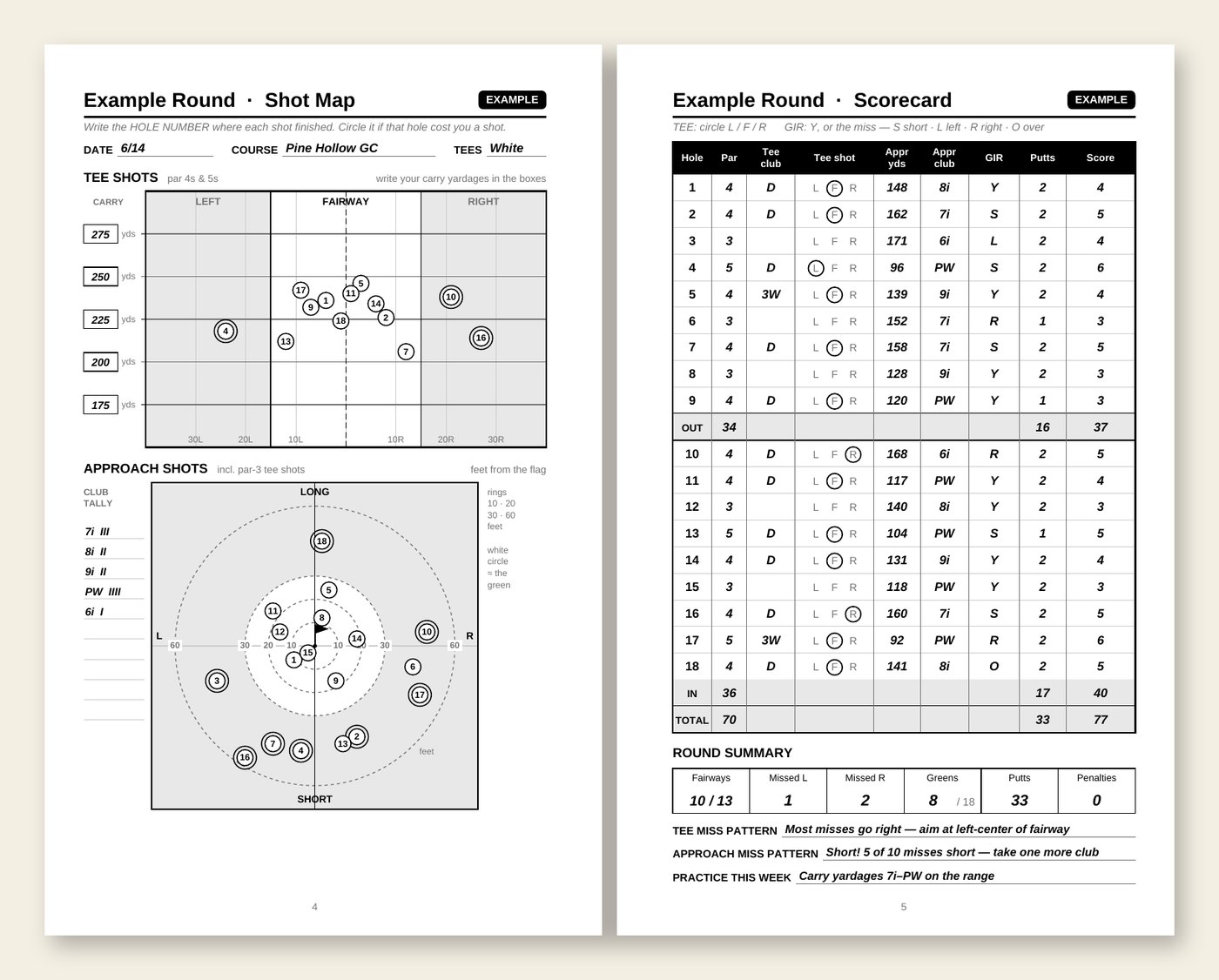
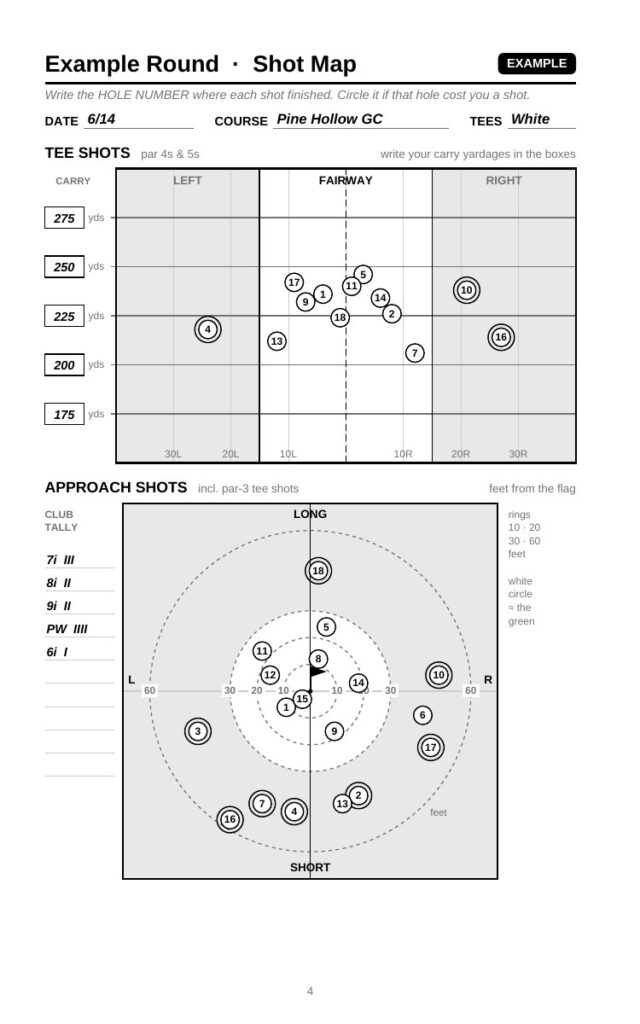
- Tee shots (par 4s and 5s). After each drive, mark where it finished: left or right of the middle of the fairway, and roughly how far it carried.
- Approach shots (including par-3 tee shots). Mark where the ball finished compared with the flag. Rings at 10, 20, 30 and 60 feet make it quick to estimate.
- Write the hole number instead of a dot. That one detail lets you look back later and see which holes, clubs or situations caused the misses.
- Circle the costly ones. If a miss cost you a shot (penalty, bad lie, missed up-and-down), circle it. These are the ones to fix first.
What to look for after 3 to 5 rounds
- Short or long? Count approaches that finished short of the flag versus past it. Many amateurs come up short far more often than long. If that’s you, you probably carry the ball shorter than you think.
- Left or right bias. Do tee shots cluster on one side of the fairway? A consistent side is good news: it’s predictable, so you can aim for it.
- How wide is the pattern? Your typical spread tells you how much room you really need, and when to stop aiming at tucked pins.
- Which numbers are circled? If the costly misses all share a side or a club, that’s your first practice priority.
Turning your pattern into strategy
- Approaches mostly short: take one more club, or aim for the middle-to-back of the green.
- Drives mostly miss right: aim at the left-center of the fairway so your normal miss still finishes in play.
- Wide approach pattern: aim at the center of the green and favor the side away from water, bunkers or short-siding yourself.
- Tight pattern with one club: that’s a club you can trust. Build your layups and tee-shot choices around it.
Track it yourself
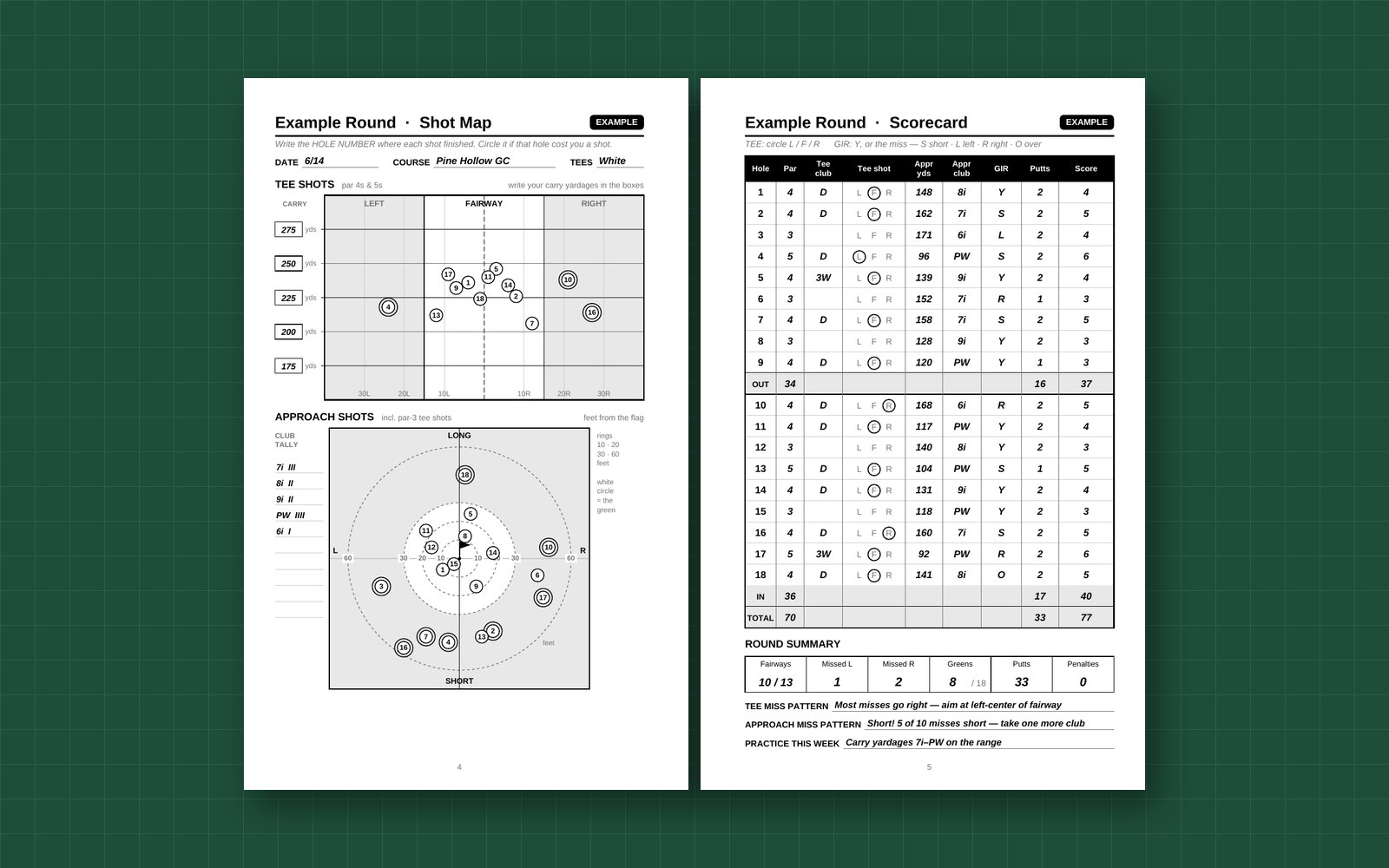
You can do all of this on the back of a scorecard. I designed the Shot Dispersion Notebook to make it faster: a tee-shot grid with your own yardages, an approach grid with 10/20/30/60 ft rings, and a scorecard on the facing page, so a full round fits on one spread.
Whatever you use, the key is consistency: record every tee shot and approach for five rounds, then look at the page. Your real pattern is usually different from the one you thought you had.